
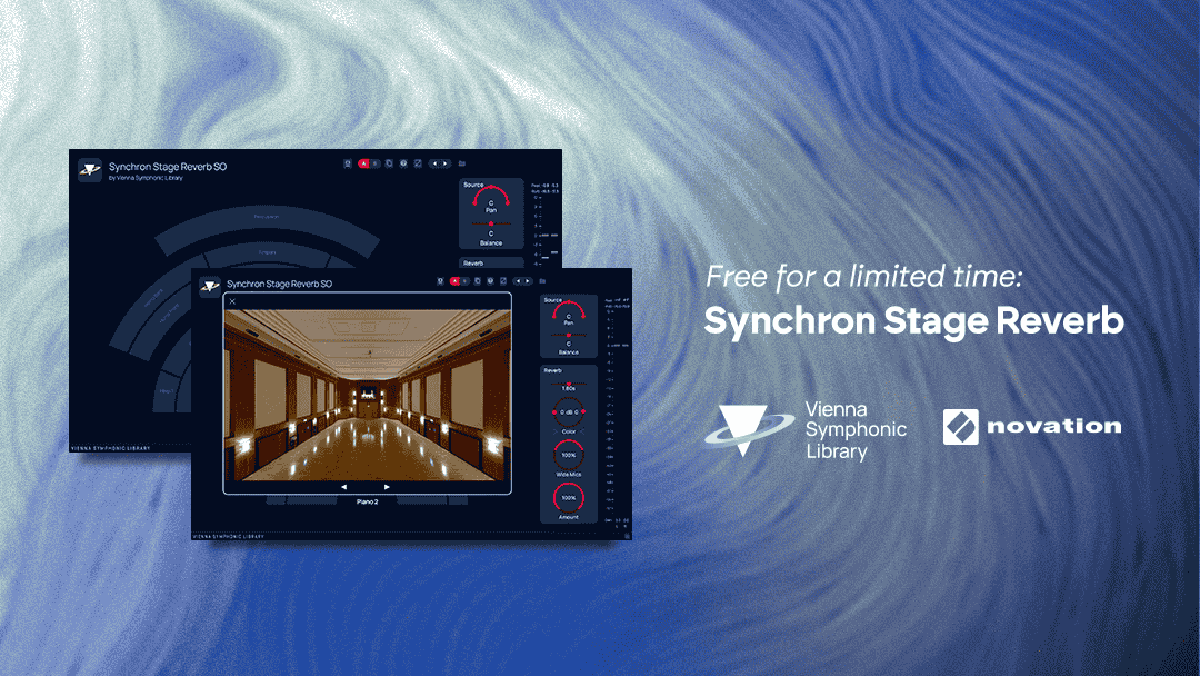

A free convolution reverb that is actually good?#
A surprise to be sure, but a welcome one#
I was browsing the internet when I accidentally came across a post about a free version of the Synchron Stage Reverb, that was available for owners of focusrite/novation devices.
Since I’ve had the Novation Launchkey 25 mk2 midi keyboard for a long time, every now and then I’ve checked the the focusrite account page for any freebies, which there have not been much for some time now, so I got really lucky I stumbled across this post before the freebie offer timed out 😁.
I’ve been using the Spaces II convolution reverb by EastWest for quite a while now, to some form of success, and the reverb itself sound great and has been pretty ok to use after I got my head wrapped around it, but the plugin is a bit too heavy for my system, so I’ve only been using a few instances of it as sends for all the different orchestral sections in my DAW.
When the Synchron Stage Reverb reverb originally came out last year, I tried out a trial version of it and really liked the ease of use and sound of it, and most importantly the plugin felt a lot more lightweight compared to the Spaces II reverb…
But since I already had Spaces II, I felt that instead of just going for the new shiny thing I would work with what I already have, which is a sort of belief I’ve been following for some time now.
Once upon a time#
Back when I first started to learn writing orchestral music and using sampled instruments, I did a pretty substantial investment at the time and bought the Hollywood Orchestra Gold package (HWO) from EastWest, which had all of the instruments one could need for orchestral works.
But I had a lot of trouble working with the HWO sounds, and I mistakenly believed at the time, that the samples were the problem and so after a year or so iirc, I bought a new string library from a sale (8Dio Anthology strings), and working with those was a bit easier than the strings in the HWO, but it still felt tough to use them.
A lot later on in time, I finally came to the realization that the samples were never the problem, but instead it was just my own lack of skills in Arranging and Orchestration.
If I was not self taught and actually had attended music school/conservatory or some form of formal composing lessons, I’m sure a teacher would’ve made me realize that from the start, but when I realized my lack of skills, I decided to start practicing writing orchestral music in a notation software using the Noteperformer software to produce the orchestral sound playback straight from the notation itself.
At this point in time, I really feel that the combination of Noteperformer and a notation software to learn orchestration and arranging was tremendously helpfull for learning, and I probably would still be hitting my head against the wall thinking that a new sample library would make my writing better, had I not found out about Noteperformer and started to use notation instead.
I’m still not really proficient with orchestral writing, but I’ve at least learned enough that I can actually work with the HWO sounds without a problem, compared to the beginning where I thought the the sounds were not good at all…
But the funny thing is, is that very same library I had thought to be bad, ended up being a very good one and the only problem with it was the user themselves 😅
Now, there actually is one thing about the HWO library that has been an issue for me, even after learning a bit about orchestral writing, and that was the pretty upfront dry-ish sound of the whole library, which tended to be an issue when I wanted a more distant spacious Concert Hall feel to it.
Since the library is pretty old, I looked through forums for how to make it less in your face and dry, and all the recommendations said to use a lot of reverb to make the sounds more spacious/wet.
I’m not really proficient at the whole production side of music, so all my efforts of trying that just ended up making the whole sound muddy and blurry, which is, let’s say, not ideal? 🤣
But after a long time I started to grasp how it should be done, and learned some production techniques that helped a lot and have used them constantly ever since, like the so called Abbey Road Trick of cutting a lot of low and high end of the signal on a send before a effect like a reverb or delay, thus making the end sound a lot less muddy..
I also learned about convolution reverbs where you can have actual captured reverbs of all the orchestral sections in their respective positions in a hall, which lead me to get the aforementioned Spaces II convolution reverb from the same company who made the HWO library, since that had captured reverbs for all of the orchestral sections inside a concert hall!
So while it has been good enough, and I feel I’ve got some sort of a working setup using it to get the room sound I’ve wanted, but as I mentioned earlier, the plugin is pretty resource intensive and my computer is not really top of the line, so this free version of the, what felt like more lightweight convolution plugin, instantly got me messing around with it, testing if it could replace Spaces II and actually work better for me.
Testing#
When I have used Spaces II I’ve had a instance of it for each of the orchestral sections (WOODWINDS,BRASS,PERCUSSION,CHOIR,STRINGS) on their own FX Busses that i then sent audio to from each instrument, to get the feel of space that I wanted.
Now that worked well enough, but even with only 5 instances of Spaces II the cpu and ram usage was a bit too much for my system and lead to me needing to up the buffer size on my audio interface quite a bit when i used more than a few instruments on a project file.
For the Synchron Stage Reverb (shortened to SSR), I decided to really test the limits of how much I can use it, and slapped a instance of it for each of the orchestral sections/families it had recorded positions for, with the SSR SO version having 16 different positions in the orchestra to choose from, with separate ones for all the string sections, 2 piano positions mid and left, a left and right harp seating, timpani, horns on the left and then section positons for the woodwinds, rest of the brass on the right and the percussion on the back.
Now on the SSR SO version there was none of the VOCAL positions, so the choir placement reverb was not available, but I downloaded the other free LITE version of SSR and that had center front,center mid, and center back generic location reverbs, so I used the center back location for my choirs and it worked reasonably well for that.
In this test I had over 4-5x more of the SSR plugins loaded than i previously had of the Spaces II, but suprisingly the performance was not too bad compared to Spaces II.
Now since I had a lot reverb instances on all the different group tracks for my orchestra the cpu usage was a bit higher than on the previous setup, but the sound of the SSR is great and no worse than what I previously had with Spaces II + the ease of use with this reverb was great, since I had it as insert effects this time and the plugin has a great feature, where if you hold down the ALT key while tweaking parameters, it changes them on every single instance of the plugin! Which sounds simple enough, but makes it really easy to dial in the wet/dry amount to taste and I absolutely love that feature.
I also tested out recording some short vocal parts and they blended nicely with all the orchestral sounds when i used general purpose center front and center back positions to place the recordings in the room, with the center front used for a solo singer and the center back to blend other recordings with the choir.
Now the VSL makers of SSR SO recommend using the reverb 100% wet as an insert for dry sounds, and the HWO samples are pretty dry, but I feel that using that 100% wet is a tad too distant sounding and I will probably need to spend a few days trying different amounts of the wet/dry mix to get a feel for what feels best to me, that of course means listening back to different amount versions with fresh ears, so it will take some time to get things perfect 😉
But, at least for now, I’m really feeling this is the one for me!
I took the midi from a old sketch that I made while testing the Musio subscription service sounds, and put them on the HWO sounds to demo the reverb,